Mortgage Rates: Election Outcomes and Impacts


Mortgage Rates: Election Outcomes and Impacts

While mortgage rates have shown sensitivity to political and economic changes around presidential elections, they are not necessarily correlated. Various factors, including Federal Reserve policies, economic conditions, and market sentiment, influence these fluctuations. Understanding the broader economic context can help provide insights into how election outcomes might impact mortgage rates.
Impact of Obama's Elections on Mortgage Rates
During Barack Obama’s first election in November 2008, the economy was in the midst of the Great Financial Crisis. The 30-year fixed mortgage rate stood at 6.09% but dropped significantly to 5.13% by February 2009 and further to 4.93% by the end of the year. This decrease was primarily due to the Federal Reserve’s intervention through the purchase of mortgage-backed securities to stabilize the financial system and lower borrowing costs amid economic turmoil.
In contrast, Obama's re-election in November 2012 saw minimal movement in mortgage rates. The 30-year fixed mortgage rate was around 3.35% in November and slightly increased to 3.53% by February 2013, ending the year at 4.48%. This stability was attributed to continued economic recovery efforts and steady Federal Reserve policies from the initial crisis management period.
Impact of Reagan's Elections on Mortgage Rates
Ronald Reagan's election in November 1980 occurred during a period of high inflation and economic stagnation, known as stagflation. The 30-year fixed mortgage rate was 14.21% in November 1980 and rose to 15.13% by February 1981, peaking at 16.95% by the end of that year. The high rates were a result of the Federal Reserve’s aggressive interest rate hikes to combat inflation.
Reagan’s re-election in 1984 marked the beginning of a significant economic turnaround.
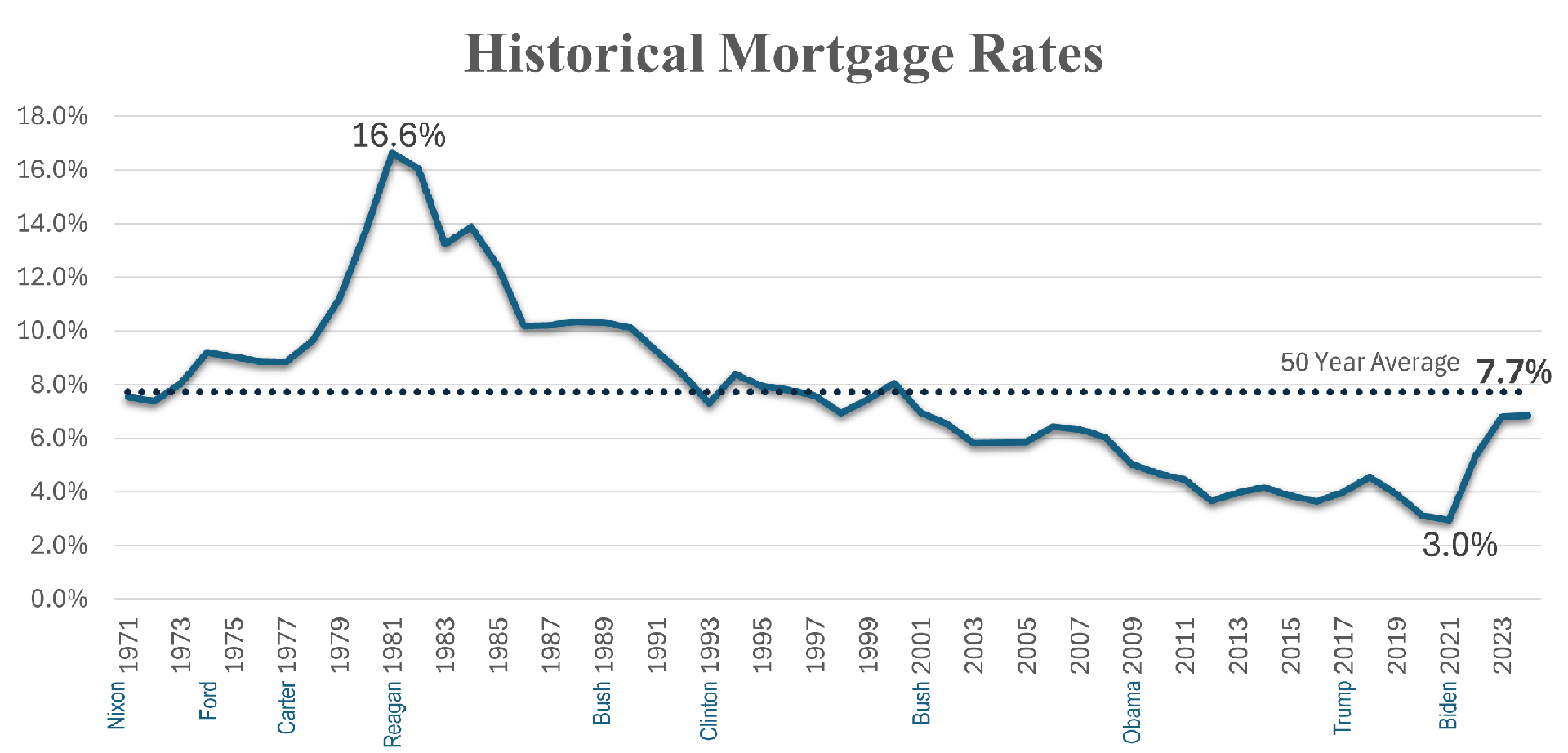
The mortgage rates started to decline, with the 30-year fixed rate dropping from 13.64% in November 1984 to 12.92% by February 1985, and further down to 11.26% by the end of the year. This decline reflected improved economic conditions and successful anti-inflationary measures implemented during Reagan's first term.
Current Election Cycle Projections
As we approach the upcoming election, the impact on mortgage rates will depend largely on the new administration's fiscal and economic policies. If the elected administration prioritizes economic stimulus and infrastructure spending, this could lead to higher inflation expectations, prompting the Federal Reserve to raise interest rates to control inflation. Conversely, policies that focus on reducing deficits and controlling spending might help keep inflation in check, potentially stabilizing or even lowering mortgage rates. Historically, interest rates have averaged 7.7% over the past 50 years and given the most recent news from the Fed and trends in the economy, they are expected to stay in that vicinity through the new year. Regardless of the rates, homeownership has consistently been the best investment Americans can make financially.
If you'd like to learn more about how to accomplish your real estate goals, contact our team at ops@canerealestate.com or call us at 858-923-4882
- Ted K.
Should you require assistance in navigating our website or searching for real estate, please contact our offices at 858-502-9800.
Brian Cane | Keller Williams Realty DRE# 01423505 | 01932411
 Based on information from California Regional Multiple Listing Service, Inc. as of September 23, 2026 7:24 PM UTC This information is for your personal, non-commercial use and may not be used for any purpose other than to identify prospective properties you may be interested in purchasing. Display of MLS data is usually deemed reliable but is NOT guaranteed accurate by the MLS. Buyers are responsible for verifying the accuracy of all information and should investigate the data themselves or retain appropriate professionals. Information from sources other than the Listing Agent may have been included in the MLS data. Unless otherwise specified in writing, Broker/Agent has not and will not verify any information obtained from other sources. The Broker/Agent providing the information contained herein may or may not have been the Listing and/or Selling Agent.
Based on information from September 23, 2026 7:24 PM UTC The information being provided by CRMLS is for the visitor's personal, noncommercial use and may not be used for any purpose other than to identify prospective properties visitor may be interested in purchasing. The data contained herein is copyrighted by CRMLS, CLAW, i-Tech MLS, PSRMLS and/or VCRDS and is protected by all applicable copyright laws. Any dissemination of this information is in violation of copyright laws and is strictly prohibited.
Any property information referenced on this website comes from the Internet Data Exchange (IDX) program of CRMLS. All data, including all measurements and calculations of area, is obtained from various sources and has not been, and will not be, verified by broker or MLS. All information should be independently reviewed and verified for accuracy. Properties may or may not be listed by the office/agent presenting the information.
 This information is deemed reliable but not guaranteed. You should rely on this information only to decide whether or not to further investigate a particular property. BEFORE MAKING ANY OTHER DECISION, YOU SHOULD PERSONALLY INVESTIGATE THE FACTS (e.g.square footage and lot size) with the assistance of an appropriate professional. You may use this information only to identify properties you may be interested in investigating further. All uses except for personal, non-commercial use in accordance with
the foregoing purpose are prohibited. Redistribution or copying of this information, any photographs or video tours is strictly prohibited. This information is derived from the Internet Data Exchange (IDX) service provided by San Diego MLS. Displayed property listings may be held by a brokerage firm other than the broker and/or agent responsible for this display. The information and any photographs and video tours and the compilation from which they are derived is protected by copyright.Compilation © 2026 San Diego MLS. Last Updated: September 23, 2026 7:08 PM UTC
Show More...
This information is deemed reliable but not guaranteed. You should rely on this information only to decide whether or not to further investigate a particular property. BEFORE MAKING ANY OTHER DECISION, YOU SHOULD PERSONALLY INVESTIGATE THE FACTS (e.g.square footage and lot size) with the assistance of an appropriate professional. You may use this information only to identify properties you may be interested in investigating further. All uses except for personal, non-commercial use in accordance with
the foregoing purpose are prohibited. Redistribution or copying of this information, any photographs or video tours is strictly prohibited. This information is derived from the Internet Data Exchange (IDX) service provided by San Diego MLS. Displayed property listings may be held by a brokerage firm other than the broker and/or agent responsible for this display. The information and any photographs and video tours and the compilation from which they are derived is protected by copyright.Compilation © 2026 San Diego MLS. Last Updated: September 23, 2026 7:08 PM UTC
Show More...
